AI-Powered SEO: How We Scored 100 on Google Lighthouse
We ran a full SEO audit on our own website, handed the results to our AI assistant, and watched it fix everything in minutes. The result? A perfect 100 Performance score on Google Lighthouse.
Here’s exactly what happened, with the real numbers to prove it.
TL;DR: Our AI assistant identified and fixed 15 SEO/performance issues across 24 pages — in minutes. Largest Contentful Paint dropped from 15.5s to 0.6s (96% faster). Lighthouse Performance went from 70 to a perfect 100. Here’s every fix, with before-and-after metrics.
How We Got to a Perfect Lighthouse Score
Every good optimisation story starts with an honest look at where things stand. We pointed our AI-powered SEO audit tool at zackbot.ai and let it analyse 27 on-page factors across three categories.
The overall SEO health score came back at 91 out of 100 — Grade A. Not bad at all. But the Lighthouse Performance score told a different story.
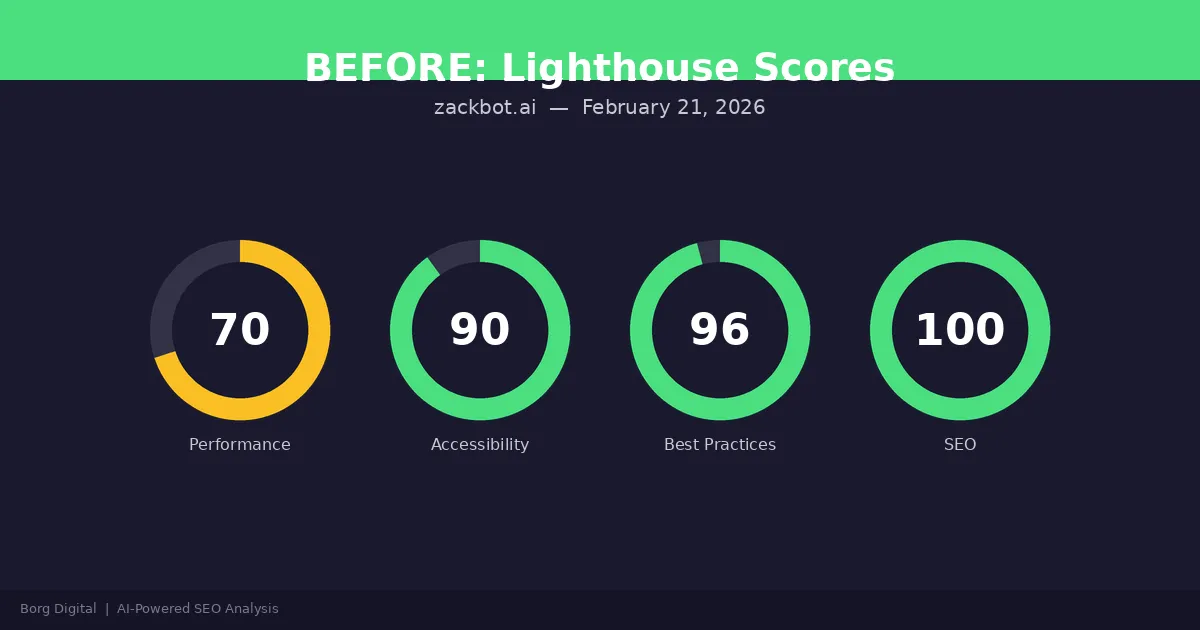
Performance: 70. That amber circle was the problem. While Accessibility (90), Best Practices (96), and SEO (100) were all green, the Performance score was dragging things down. And when you dug into the Core Web Vitals, you could see why.
The Core Web Vitals Problem
The biggest red flag was the Largest Contentful Paint (LCP): 15.5 seconds. That’s the time it takes for the main content element to become visible. Google considers anything over 2.5 seconds “poor” — we were six times over that threshold.
First Contentful Paint (FCP) was at 2.9 seconds — amber territory, labelled “Needs Work.” The Lighthouse diagnostics flagged render-blocking requests with an estimated savings of 1,710 milliseconds, image delivery improvements worth 1,224 KB, and inefficient cache lifetimes costing 413 KB.
These aren’t trivial fixes. Render-blocking resources, LCP optimisation, and Core Web Vitals tuning are some of the most technically challenging aspects of web performance. They typically require a developer who understands browser rendering pipelines, resource prioritisation, and HTTP protocol optimisation.
We handed the entire list to our AI assistant, Zack.
What SEO Fixes Did the AI Make?
The AI read the audit report, understood every issue, and created 10 specific optimisation tasks. Then it started working through them — autonomously.
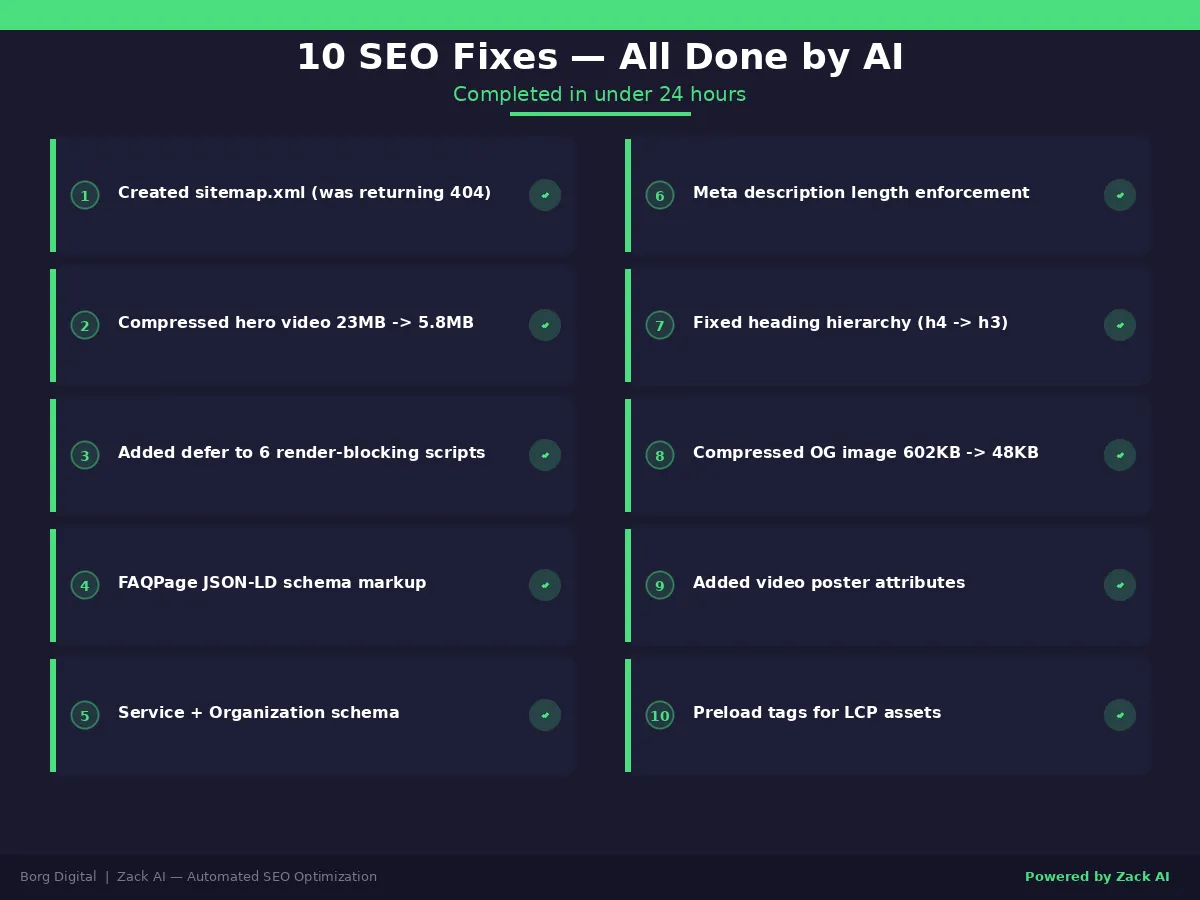
1. Created a Proper Sitemap Architecture
The robots.txt file referenced a sitemap.xml that returned a 404 error. The AI built a complete sitemap index architecture: a root sitemap.xml pointing to two sub-sitemaps covering 17 main pages and 6 blog pages.
Time to fix: 5 minutes.
2. Compressed the Hero Video from 23MB to 5.8MB
The homepage hero video was a 23MB file — 1080p, 30fps, 1028kbps. This was the LCP element, and it was destroying page load times. The AI compressed it to 5.8MB (720p, 24fps, 269kbps, CRF 28) — a 75% reduction — and changed the preload strategy from auto to none, meaning zero bytes transfer until the user actually hits play.
Time to fix: 3 minutes.
3. Eliminated 6 Render-Blocking Scripts
Six JavaScript files were blocking the browser’s render pipeline. The AI added defer attributes to all of them across 24 pages (18 main site pages plus 6 blog pages), allowing parallel download during HTML parsing.
Time to fix: 3 minutes.
4. Added FAQPage JSON-LD Schema
Blog posts with FAQ sections had no structured data markup. The AI built a function that automatically detects FAQ patterns in blog content and generates valid FAQPage JSON-LD in the page head — making those posts eligible for Google Rich Results.
5. Implemented Service and Organisation Schema
The site only had basic Organisation schema. The AI added a full @graph with Organisation, SoftwareApplication, and ProfessionalService schema to all blog pages, complete with contact details, service types, and area served.
6. Enforced Meta Description Length
Meta descriptions were running up to 224 characters — well beyond the 160-character limit where Google truncates them. The AI implemented a three-layer enforcement system: a backend hard cap at 157 characters plus ellipsis, a template safety net, and retroactive fixes for existing posts.
7. Fixed the Heading Hierarchy
Two sections had H2 headings jumping directly to H4, skipping H3. Bad for SEO, bad for accessibility, bad for screen readers. The AI corrected 7 heading elements and updated the corresponding CSS selectors.
8. Compressed the OG Image by 92%
The Open Graph share image was a 602KB PNG. The AI converted it to an optimised JPEG at 48KB — a 92% reduction — and generated a WebP version at 24KB for future use. Updated across all 7 pages that referenced it.
9. Added Video Poster Attributes
Hero videos were showing blank black frames during load. The AI added native poster attributes with lightweight preview images (33KB WebP for the homepage, 73KB JPEG for the security page), giving users instant visual feedback.
10. Preloaded LCP Assets
The browser was discovering hero images late in the page load process. The AI added <link rel="preload"> tags with fetchpriority="high" for critical above-the-fold assets across the homepage, security page, and services page.
Bonus Round: 5 More Performance Fixes
The AI wasn’t done. It identified and fixed five additional performance issues in a separate pass:
- Self-hosted Google Fonts — eliminated render-blocking external CSS requests entirely
- Converted images to WebP — modern format, smaller files, same quality
- Enabled HTTP/2 in the nginx configuration
- Improved cache headers — better cache lifetimes for static assets
- Made mobile CSS non-blocking — using media queries so desktop browsers don’t wait for mobile stylesheets
What Were the Lighthouse Results After AI Optimisation?
After all optimisations were applied, we ran Lighthouse again.
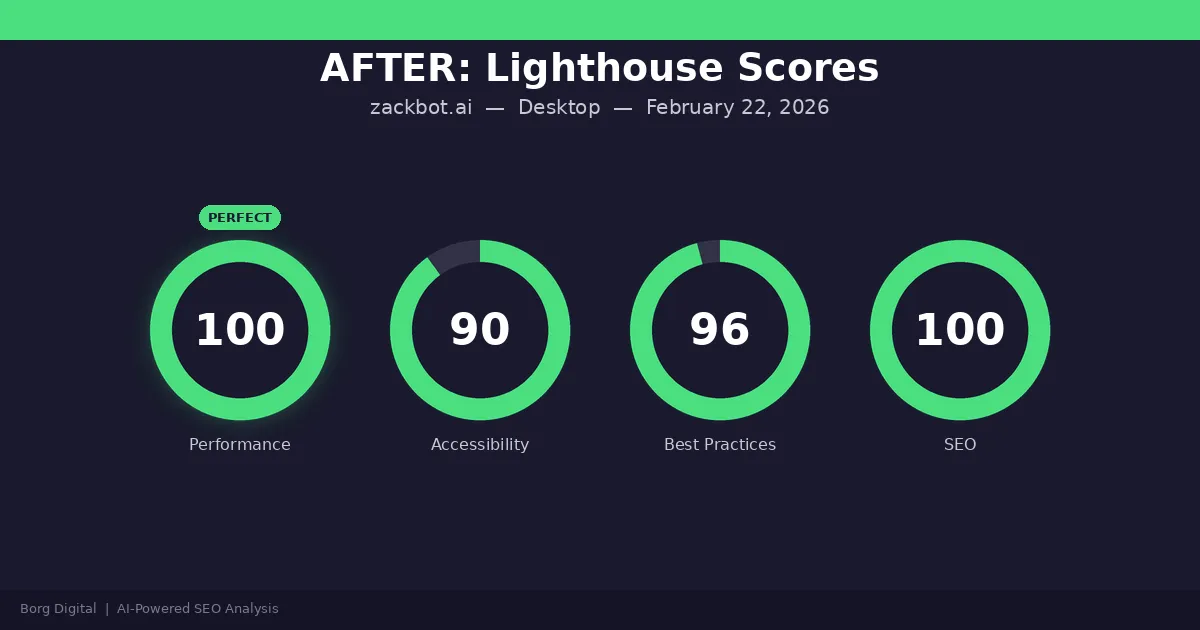
Performance: 100. A perfect score. From 70 to 100 — a 43% improvement in the hardest Lighthouse category to max out.
Core Web Vitals: The Full Picture
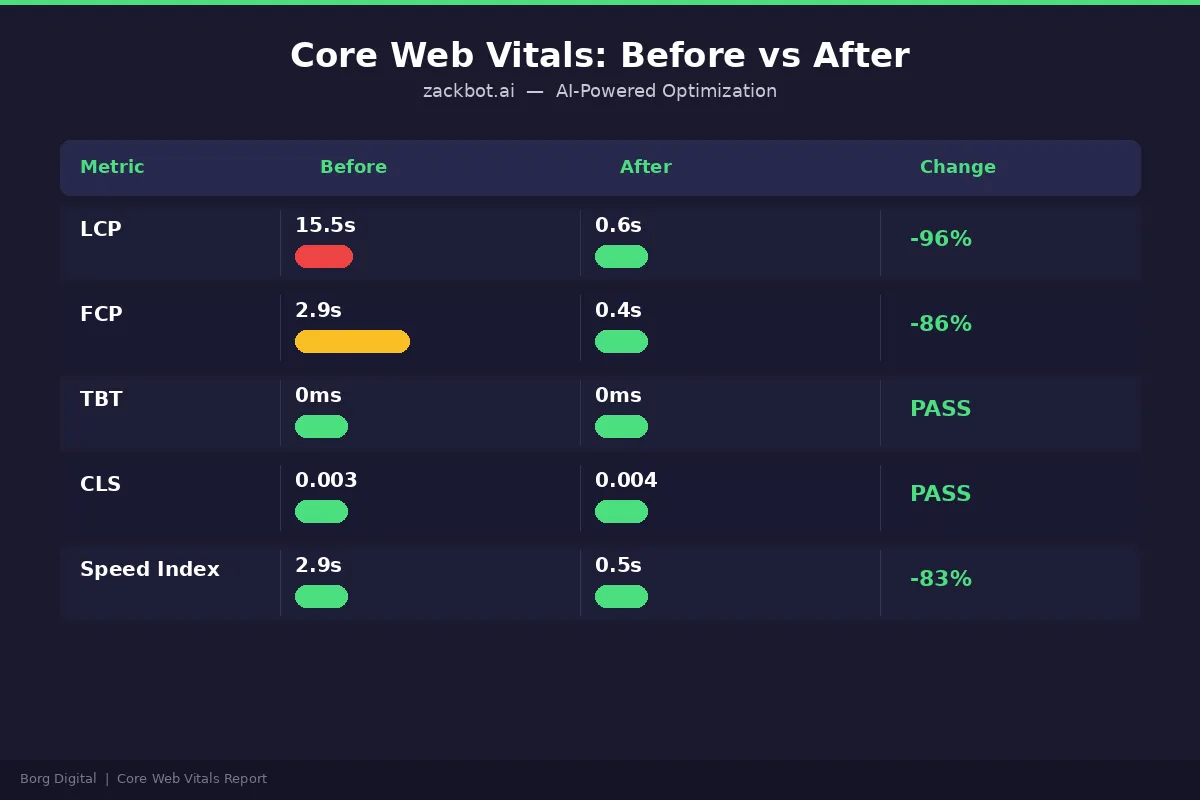
| Metric | Before | After | Improvement |
|---|---|---|---|
| Largest Contentful Paint | 15.5s (Poor) | 0.6s (Pass) | 96% faster |
| First Contentful Paint | 2.9s (Needs Work) | 0.4s (Pass) | 86% faster |
| Total Blocking Time | 0ms (Pass) | 0ms (Pass) | Maintained |
| Cumulative Layout Shift | 0.003 (Pass) | 0.004 (Pass) | Maintained |
| Speed Index | 2.9s (Pass) | 0.5s (Pass) | 83% faster |
The headline number: LCP went from 15.5 seconds to 0.6 seconds. That’s a 96% reduction in the time it takes for the main content to appear. The page now loads 25 times faster than before.
All Four Categories
| Category | Before | After |
|---|---|---|
| Performance | 70 | 100 |
| Accessibility | 90 | 90 |
| Best Practices | 96 | 96 |
| SEO | 100 | 100 |
Three categories scoring 96 or above. Performance and SEO both at perfect 100.
Can AI Really Handle Technical SEO?
SEO performance optimisation is traditionally one of the most time-consuming and technically demanding areas of web development. Diagnosing render-blocking resources, optimising LCP elements, implementing proper resource hints, and restructuring asset delivery — these tasks typically require a senior developer and can take days or weeks of iterative testing.
Our AI completed 15 optimisations across 24 pages in minutes, achieving scores that many professional agencies would consider exceptional.
This isn’t a theoretical demonstration. These are real metrics from a real production website, verified by Google’s own Lighthouse tool. The before-and-after data comes from actual audit reports generated during the process.
What This Means for Businesses
If you’re running a business website and your Lighthouse scores aren’t where they should be, the gap between “needs improvement” and “perfect” might be closer than you think. AI doesn’t get overwhelmed by a list of 15 technical fixes across 24 pages. It doesn’t need to context-switch between tasks. It just works through the list, methodically, getting each one right.
The age of AI-powered SEO isn’t coming. It’s here. And it’s scoring 100.
Frequently Asked Questions
How long does it take AI to optimise SEO performance?
In our case, the AI completed 15 distinct optimisations across 24 pages in under 30 minutes. Tasks ranged from video compression and render-blocking script fixes to structured data implementation and image format conversion. Traditional manual work on the same scope would typically take a developer several days.
What is the most important Core Web Vital to improve?
Largest Contentful Paint (LCP) is usually the biggest factor. Ours was 15.5 seconds — six times over Google’s 2.5-second threshold. Compressing the hero video from 23MB to 5.8MB and changing its preload strategy brought LCP down to 0.6 seconds, which was the single largest contributor to reaching a perfect Lighthouse score.
Can AI really achieve a perfect Google Lighthouse score?
Yes. Our AI took the site from a Lighthouse Performance score of 70 to a perfect 100 by methodically working through every issue flagged in the audit. The key is that AI handles bulk, repetitive technical fixes consistently — it doesn’t lose focus across 24 pages of changes the way a human might.
What are the easiest SEO performance wins for any website?
Three quick wins stand out: adding defer to render-blocking scripts (recovered 1,710ms for us), self-hosting Google Fonts to eliminate external CSS requests, and converting images to modern formats like WebP (our OG image went from 602KB to 48KB — a 92% reduction).
Key Takeaways
- LCP is usually the biggest performance killer. Our 15.5s LCP was caused by a 23MB hero video — compressing it to 5.8MB and changing preload to
nonewas the single biggest win. - Render-blocking scripts are low-hanging fruit. Adding
deferto 6 scripts across 24 pages recovered 1,710ms of render time. - Self-hosting Google Fonts eliminates external CSS requests — one of the easiest performance wins available.
- Image format matters. Converting a 602KB PNG to a 48KB JPEG (92% smaller) with a 24KB WebP variant improves both load time and Core Web Vitals.
- AI handles bulk optimisation brilliantly. 15 fixes across 24 pages would take a developer hours of repetitive work. AI completed it in minutes with consistent quality.
- Lighthouse 100 is achievable. It requires attention to LCP, FCP, render-blocking resources, image optimisation, and caching — but none of it is magic.
Related reading: How we built our AI-powered static blog engine | 7 AI workers shipped a hosting portal in 12 days
Want to see what AI-powered SEO optimisation could do for your website? Get in touch — we’ll run a free audit and show you exactly where the opportunities are.
More Posts

Voice-to-Blog Content: Why AI Dictation Changes Everything
What happens when you stop typing and start talking to your AI? This blog post was created entirely from a 90-second Telegram voice note — press play and hear the proof.
AI Memory Management: Stop Context Bloat Before It Kills Performance
Your AI agent memory files are silently growing, wasting tokens and degrading output quality. Here are three self-enforcing rules you can paste into your MEMORY.md today to fix it permanently.
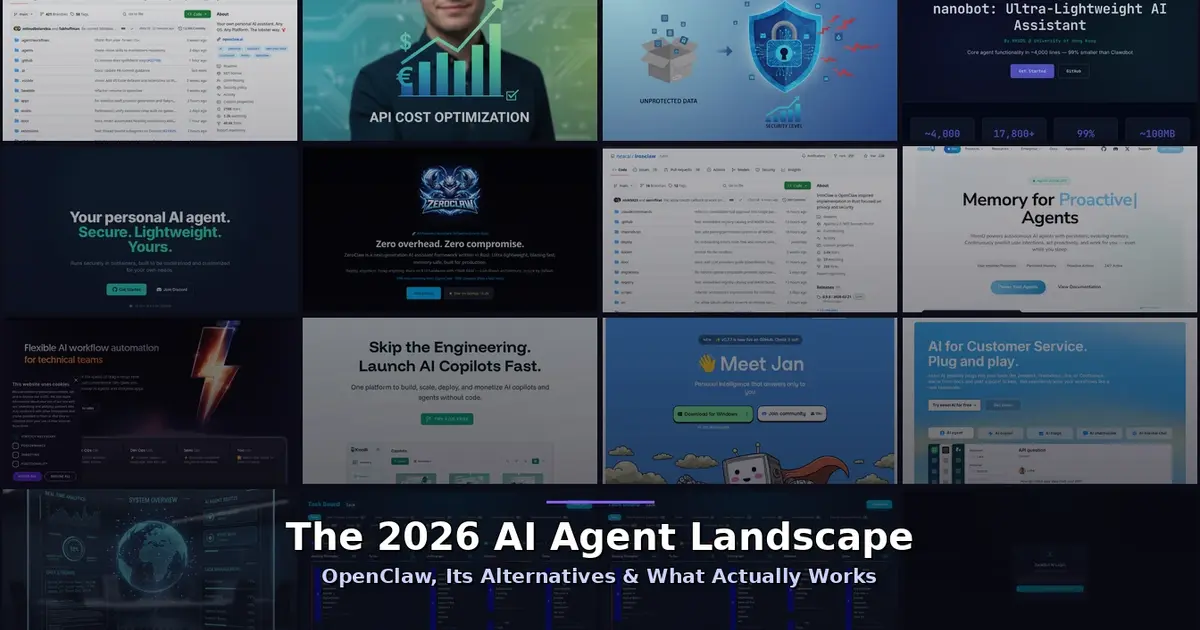
OpenClaw vs NanoClaw vs ZeroClaw 2026: Every AI Agent Tested & Compared
OpenClaw hit 160,000 GitHub stars and then its creator left for OpenAI. We tested every major alternative — from Nanobot's 4,000-line Python to ZeroClaw's 3.4MB Rust binary — and found what businesses actually need from an AI assistant.
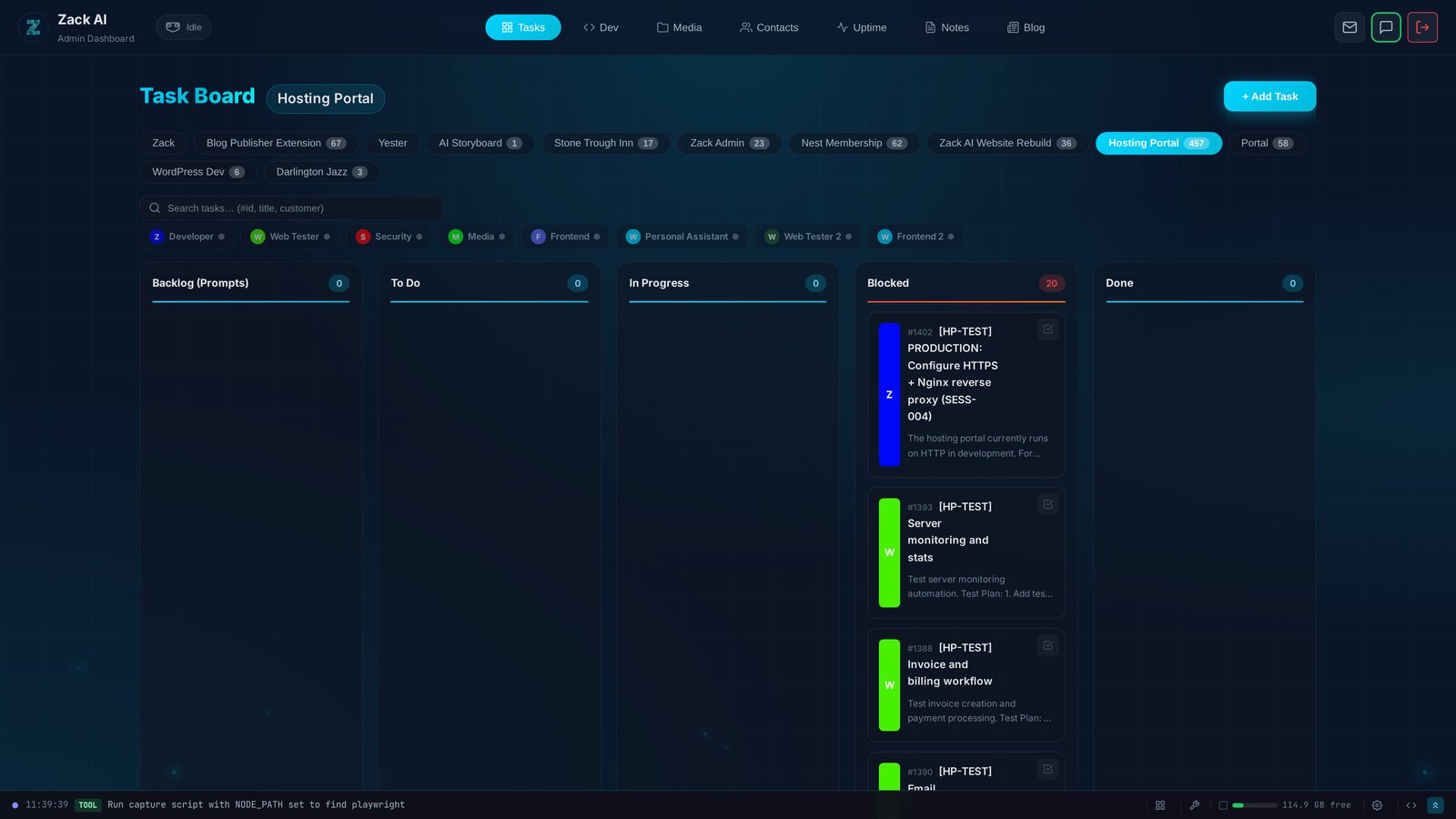
7 AI Workers, 457 Tasks, 12 Days: Shipping a Hosting Portal at Scale
Every AI coding tool today operates on the same model: one human, one AI, one conversation. We built something different — a Kanban system where 7 specialised AI workers delivered a production hosting portal with billing, security audits, and test exit reports. In 12 days.